Peace Country · Rivers, arts & heritage
The river changes how you read the land.
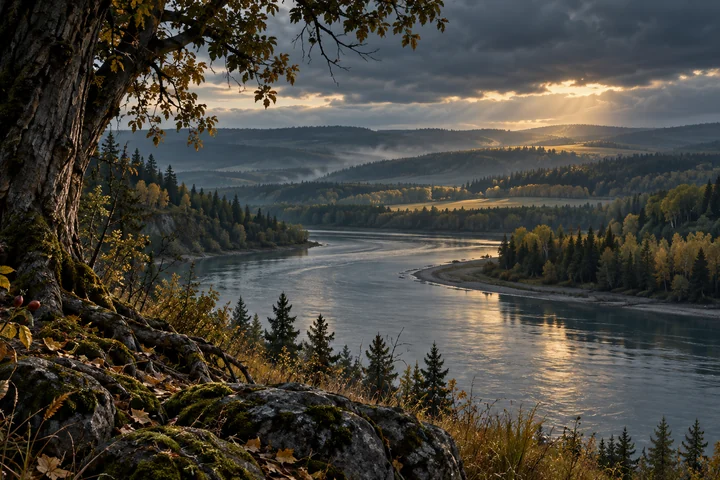
From above, a river may appear to be a single line through the country. Closer attention reveals a sequence of banks, wooded slopes, terraces and openings. The land across the water can look near while belonging to a very different route through the region.
Notice how that sequence affects the view. A group of trees in the foreground gives scale to a distant field; a bend partly conceals the next reach. There is depth without the need for an alpine skyline. The drama comes from the relationship between landforms and light.
Spend time in public places at more than one hour. A slope that seems quiet under grey cloud can become the main subject when the sky opens. The lasting pleasure may lie in watching that change rather than finding a permanently spectacular angle.
For a home search, describe which part of the landscape matters to you. An upland setting, an enclosed grove and a verified river view are different desires. A beautiful regional image cannot establish the circumstances of an individual parcel.
Peace Country · Rivers, arts & heritage
A museum visit gives the valley a human scale.
The Peace River Museum, Archives & Mackenzie Centre brings local Indigenous history, the town, river travel and fur-trade subjects into its galleries. Its archival resources also include photographs, reference files and regional books, with research access by appointment.
Begin with the river as a place of movement and work. Objects associated with travel can lead into questions about knowledge, labour, supply and the relationships that made a journey possible. They become more interesting when people remain in the account.
Then look for a smaller story. A photograph of a street, a record connected with a business or a household object can make a large regional history feel close. Ask what is known and what remains uncertain; the unanswered question may become the reason you return.
The museum shop features local makers, producers and regional publications. A book or a carefully chosen object can carry the visit forward, giving a country library or a room a connection that is more personal than a generic regional souvenir.
Peace Country · Rivers, arts & heritage
At the railway station, imagine the work of an arrival.
The town’s NAR Station was built in 1916 for the Central Canada Railway and later became part of Northern Alberta Railways. Restored rooms and displays interpret the station’s earlier use, with summer visitor information and museum programming.
Look at the building as an arrangement for receiving people and goods. An entrance, a waiting room and the relationship to the railway each had a practical purpose. The architecture’s character is connected with those daily uses.
A station visit can also change how you think about distance. An arrival once depended on a transport network, a timetable and considerable time. A map of the region gains another dimension when you consider the effort behind journeys now treated as routine.
The published visitor season runs between the May and September long weekends. As this guide was checked in October 2026, that seasonal schedule does not establish current drop-in access. Plan an interior visit with the museum, and distinguish it from simply looking at the exterior.
Peace Country · Rivers, arts & heritage
Dunvegan’s history begins before the trading post.
Historic Dunvegan’s account identifies the valley as a gathering place used for thousands of years on the traditional lands of the Tsattine, or Beaver, people. The North West Company’s trading post, established in 1805, belongs to a later part of that history.
Keep that order in mind when looking at the surviving buildings. They are evidence of particular institutions and activities, not the beginning of human life in the valley. A well-preserved room can be compelling while still representing only one part of the place.
The Beaverland Alberta storytelling collection offers recordings and accounts shared by Tsattine elders, knowledge keepers and others, including work developed with Historic Dunvegan. Listening to a named person’s account can bring a perspective that an architectural visit alone cannot supply.
Approach those stories as the speakers’ knowledge and experience. Their value lies in listening and learning, with the context supplied by the hosts, rather than taking a story or image away as a decorative theme for a country home.
Peace Country · Rivers, arts & heritage
Four buildings, many kinds of daily life.
Historic Dunvegan presents four original restored and furnished buildings with interpretation of Indigenous, fur-trade and mission histories. The site lies south of Fairview, in the Peace River valley, and deserves a visit planned around its own programme.
Inside a historic building, pay attention to the ordinary arrangements. Where did work happen? How did a room receive light? Which objects were used repeatedly, and which carried institutional or personal significance? These questions can make a furnished interior more absorbing than an inventory of attractive antiques.
Restoration itself is another subject to explore. Ask which elements are original, which have been repaired or reproduced and what evidence guided the decisions. Understanding those choices allows you to appreciate both the surviving material and the work that makes it legible.
The operator’s 2026 visitor-centre and historic-building season ended September 7. The adjacent Alberta Parks campground is a separate operation. A campground booking or a landscape visit does not establish access to the historic interiors; use the site’s current information for a future guided visit.
Peace Country · Rivers, arts & heritage
Shaftesbury offers another way to follow the valley.
The Municipal District of Peace’s Shaftesbury Trail study identifies a shoreline with cultural, historical and environmental significance. It is a useful reminder that a scenic road also passes through a lived and worked landscape.
Treat a drive as an opportunity to notice relationships: how fields meet trees, how the road follows changing ground and where a public stopping place allows a view. The journey need not become a hunt for a single famous overlook.
Choose stops from current public visitor information and allow the road itself to remain a road. An appealing entrance, garden or riverbank on adjoining land is not an invitation to enter. You can appreciate the pattern of a place without interrupting its ordinary work.
If the valley holds your attention, return with a more focused interest—a museum question, a particular public destination or a wish to see another season. Familiarity grows through these smaller returns.
Peace Country · Rivers, arts & heritage
Grande Prairie’s gallery opens the landscape to new questions.
The Art Gallery of Grande Prairie connects the region with contemporary exhibitions and a permanent collection. It is a place to encounter art as a current conversation, including work that may challenge the first impressions you formed from the surrounding landscape.
Timing matters for this visit. The gallery’s October 6, 2026 reopening announcement schedules the public reopening for October 15 at 6 p.m. following renovations. As checked October 11, that is an upcoming reopening, not evidence that the galleries are already open.
The announcement introduces three autumn exhibitions. Shape of Shape brings collection works, Canadian artists and Northwestern Polytechnic student work into dialogue. Use the gallery’s current exhibition pages for the programme and dates rather than treating a reopening event as the full season.
Allow yourself to be surprised. A gallery day need not confirm that Peace Country is beautiful; it can make you think differently about form, ecology, identity or the relationship between a place and the people making work within it.
Peace Country · Rivers, arts & heritage
A collection can become a map of attention.
The gallery’s permanent-collection page introduces works by artists including Robert Guest, Euphemia McNaught, Ester Gibson and Joyce Brown. Its selected images offer a way to begin looking before an in-person visit.
Compare how different artists organise space. A tree may become a subject in itself; a river may appear through a study of colour; a group of marks may suggest movement without describing a recognisable view. Similar country can generate very different work.
Keep a few notes about what draws you in. You may discover that the painting you would want at home has a quieter palette or a smaller scale than the landscape you most enjoy outdoors. That difference can make a room richer.
Selected online works are not a promise of what will hang in the galleries on a particular day. Use them to develop an interest, then let the actual exhibition introduce its own relationships.
Peace Country · Rivers, arts & heritage
Robert Guest’s repeated looking offers a useful example.
The gallery’s 2014–15 annual report describes Robert Guest’s Winter on the Wapiti as a visual journal from a five-year project between 1984 and 1989. Sketches made along the river were developed in his studio cabin, creating a sustained account of a particular landscape.
That is a different model from collecting a single dramatic view. Returning allows small changes to become subjects: the shape of a bank, a tree against a different sky or the light at another hour. The place becomes familiar without becoming exhausted.
A visitor can borrow the habit of attention without imitating the work. Choose a public place to revisit, carry a notebook and record what you notice in your own way. Even a few sentences can reveal how differently you saw the same country on two days.
The annual report describes a historical exhibition and project, not a current display or access to the artist’s former cabin. The example is about a relationship with place developed over time.
Peace Country · Rivers, arts & heritage
In Beaverlodge, culture has a domestic scale.
The Town of Beaverlodge’s cultural directory introduces the Art & Cultural Centre, local art and craft groups, and the mural foundation. These are reasons to spend time in a smaller community rather than passing through on the way to a larger destination.
The centre occupies a former hospital building, a history recorded in the town’s visitor material. Its present use brings exhibitions, a shop and a tearoom into a place that has served the community in another way. Confirm the current programme before arranging a visit.
Look closely at the scale of the work. A textile, ceramic piece or small painting asks for another kind of encounter from a museum’s large installation. Ask about the maker and how the work is used; a conversation can become the most memorable part of the stop.
Community cultural life also includes people making things together. A membership studio or a local art group may offer a continuing connection if you settle nearby, with participation governed by the group’s actual arrangements rather than a visitor’s expectation.
Peace Country · Rivers, arts & heritage
A night in Demmitt begins with the hall itself.
Borderline Culture presents performances at the Demmitt Community Centre between Grande Prairie and Dawson Creek. Its account describes a timber-frame and straw-bale hall built with local and reused materials, including beetle-killed pine and a recycled gym floor.
The building is a useful architectural destination because its interest comes from material choices and collective use. A hall needs to receive people, support performance, make conversation possible and hold the less formal moments before and after the event.
Attend for the actual performance, then give the room some attention too. Notice the relation of timber to the larger space, the places people gather and the transition from the outside landscape to an interior shared with others.
Use the presenter’s current calendar for the programme and tickets. A country home near an active hall can offer a satisfying combination: privacy on ordinary days and a reason to join a roomful of people when an event interests you.
Peace Country · Rivers, arts & heritage
At Wembley, the landscape opens into deep time.
The Philip J. Currie Dinosaur Museum in Wembley presents northern palaeontology through fossil specimens, skeleton mounts and interpretation. It offers a substantial indoor destination within the wider Grande Prairie area, with programming that should be checked for the day of a visit.
Begin with the evidence rather than the spectacle. A fossil has a location, a geological context and a history of excavation and study. Understanding how a conclusion was reached can be as interesting as the reconstructed animal.
The museum’s Pipestone Creek bonebed tours are separate field experiences requiring their own booking and travel to the tour location. The page checked October 11 lists end-of-season September dates; it does not establish an available October tour or unrestricted access to a dig.
A museum day can also include Café on 43 under its current service arrangements. Let the visit occupy the time it deserves, especially with children or guests whose questions may lead the afternoon in an unexpected direction.
Peace Country · Rivers, arts & heritage
Bring the region home through a few good purchases.
The Peace River Farmers Market is part of the agricultural society’s community activity. The town’s market directory describes an approved market welcoming Alberta vendors, with handmade, baked, grown and produced goods central to its mix.
Build a visit around the current market date, not the assumption that an indoor venue means daily operation. Once there, begin with what is actually on the tables. A producer’s explanation of a food or a maker’s account of an object can make a purchase more satisfying.
Choose enough for a meal rather than trying to carry the whole region away. Bread, something to cook and a small treat can make a generous supper. Leave room in the plan for what you did not know you would find.
The same approach works for art and craft. Buy a piece you want to use or look at repeatedly, keep the maker’s name and ask how to care for it. A home gains character from these particular connections over time.
Peace Country · Rivers, arts & heritage
A home can hold both the broad view and the close one.
A river-country home does not need to expose every room to the largest panorama. A main space can open toward the wider land while a smaller room looks into a grove or garden. The change in scale gives daily life different places to settle.
Think about where you would spend an ordinary hour. A comfortable chair beside a close view may be more valuable to you than another formal reception space. A table near changing light can support work, drawing, reading and meals without becoming a room reserved for occasions.
At the threshold, simple useful details matter: a sheltered place to arrive, somewhere to leave outdoor clothing and an entrance that remains clear to a guest. Materials can be chosen for how they feel and age in use rather than for a photograph of an ideal country interior.
Discuss those ideas against a real property with the appropriate professionals. Existing structure, landform, exposure, access and approvals shape what can be achieved. A regional landscape offers inspiration, while the site supplies the actual design problem.
Peace Country · Rivers, arts & heritage
Give the garden a scale you want to live with.
Against a large landscape, a small garden can become an especially satisfying foreground. A defined place near the house offers close detail while the wider country remains visually generous. The garden and the horizon need not compete for attention.
Choose a real use first: a seat for morning coffee, a modest kitchen garden or a place to share an evening meal. Each asks different things of shelter, light and maintenance. Local advice about the particular ground and exposure should guide planting and materials.
Keep some space uncomplicated. An area that can accept a table, a few chairs and ordinary family activity may be used more often than a highly specialised outdoor feature. The measure is the life that happens there.
Look at the garden from inside as well. In the months when you spend less time outdoors, a tree, a structure or the arrangement of grasses can still make the near view interesting. The smallest part of the property may carry much of its daily pleasure.
Peace Country · Rivers, arts & heritage
Choose a base, then let each outing have a purpose.
For a Peace River stay, make the museum and a public river-country outing the first anchors. Add the NAR Station in its operating season or by confirmed arrangement. A market date can provide another reason to spend time in town.
Give Dunvegan a separate planned visit when the historic buildings are open. Its interpretation and valley setting deserve more than a hurried stop on a day already committed to Grande Prairie.
For a Grande Prairie-area stay, choose an exhibition after the gallery’s announced reopening, the dinosaur museum in Wembley or a confirmed performance in Demmitt. Beaverlodge’s cultural centre offers another kind of visit, with its own current programme.
These are separate options within a large region. Select the base and journey that fit your interests, then return for the other part of the country. There is no need to turn the map into a test of how much you can cover.
Peace Country · Rivers, arts & heritage
Build a life through the places you return to.
A country home becomes more meaningful as the surrounding places become familiar. You recognise a museum subject, return to a maker’s work or see another performance in the same hall. A wide landscape acquires a network of close connections.
Make room for participation as well as attendance. A class, a cultural group or a community event may become part of your life if its actual programme suits you. Familiarity is built by showing up with interest and allowing relationships to develop.
Compare Peace Country’s river terraces and open uplands with northeastern lake country, central Alberta parkland and southern prairie. The question is which setting, community life and pattern of journeys you would want repeatedly.
When you are ready to explore a residential acreage, bring Dusko that description. The view matters, but so do the ordinary days, the places you would visit and the kind of home that would make returning a pleasure.