Southern prairie country
Learn to see the prairie in layers.
An open landscape rewards attention to small changes. Look for the low rise that conceals a hollow, the darker band of vegetation along a drainage and the way a cloud's shadow travels across the ground. A horizon can appear almost unchanged while the nearer country shifts continuously.
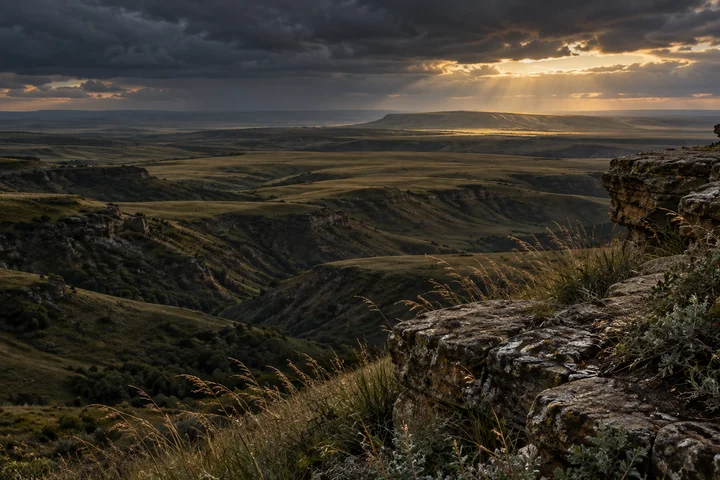
The coulees bring a different scale. From an appropriate public lookout, their folds reveal how much relief can exist beneath what first seemed level land. The most memorable view may hold several distances at once: grasses close enough to move in the breeze, a sequence of slopes and a pale line far beyond them.
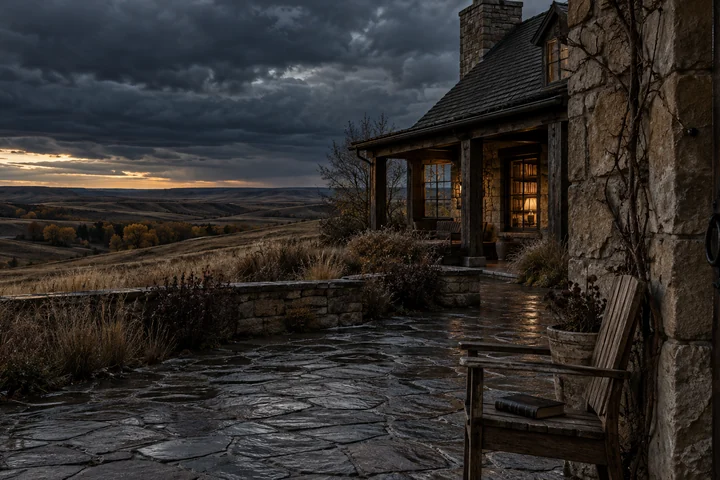
For a home, that suggests more than one kind of outlook. A broad window can welcome the sky, while a smaller sheltered opening gives a sense of closeness. A courtyard or planted space can provide an intimate foreground without trying to hide the larger country.
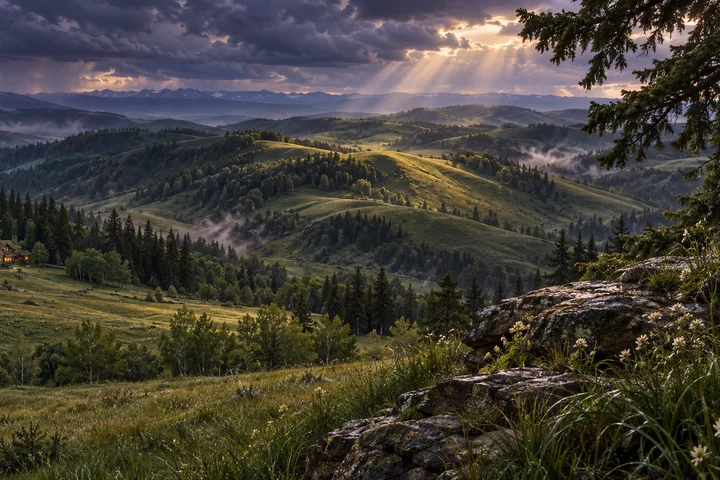
Our scene uses those layers to create atmosphere. Its house and landforms are imagined, so it offers a feeling for the region rather than identifying a parcel, a public walking route or a view available with a particular property.
Southern prairie country
Begin with the people who know the country.
Head-Smashed-In Buffalo Jump, near Fort Macleod, is a major public destination for learning about Blackfoot history and the relationship between people, bison and the land. Make its interpretation an important part of understanding the region, rather than placing it at the edge of a town-and-country itinerary.
Allow time to listen and read. A landscape that looks quiet today can hold evidence of planning, skill, cooperation and sustained knowledge. The visit is richer when you follow the account given by the site's interpreters instead of reducing the place to a dramatic cliff or a distant view.
The lesson for a country life is straightforward: knowing where you are includes knowing whose stories are being told. Choose books and cultural visits that identify their authors and sources. Purchase art through makers and galleries that can explain its origin.
Do not borrow ceremonial imagery to give a new house an appearance of local authenticity. A home can feel deeply connected to its region through respectful relationships, careful learning and original contemporary work.
Southern prairie country
Walk Fort Macleod's historic downtown.
The Town of Fort Macleod's historic-downtown guide describes an area of brick and locally quarried sandstone buildings, recognised in 1984 as Alberta's first designated historic area. It includes the Empress Theatre and the early-twentieth-century courthouse. The streets make a useful introduction to the town's built history.
Take the walk slowly enough to notice individual buildings. Look at the way a shop entrance is set into a façade, the depth of a window opening and the differences between neighbouring upper storeys. Historic character lies partly in that variety; it is more interesting than a uniformly aged finish.
Where interpretation is available, compare the present street with its earlier uses. Ask what has remained, what has been adapted and what daily work once happened behind the public frontage. A building can hold several chapters without every one being visible from outside.
For a prospective country resident, repeat the visit on an ordinary day. Town life matters through familiar places and people as well as landmarks. The most appealing nearby centre is often one you enjoy using without needing a special occasion.
Southern prairie country
Make the Empress the centre of an evening.
The Empress Theatre opened in 1912 and continues as a place for film, live performance and community life. Its history is part of Fort Macleod's character, while its current programme gives people a reason to gather there now.
Choose a performance or screening that you genuinely want to attend and build the evening around it. Allow time for dinner, arrive without rushing and look at the room before the event begins. A theatre visit offers a different sense of a town from an afternoon spent admiring its buildings.
Community venues also reveal how culture is sustained: through programming, technical work, volunteers and audiences who return. If you live nearby, becoming part of that audience can be a more meaningful connection than treating the theatre as an occasional visitor attraction.
Use the Empress calendar for actual dates. An old concert page or summer-camp announcement should remain part of the archive rather than become a promise about the coming season.
Southern prairie country
Give the heritage visit its own day.
A visit to Head-Smashed-In is best planned with enough time for the interpretation and the setting to inform one another. Check the site's current visitor information before leaving, including the arrangements for any guided programme you hope to join. Resist adding several other distant heritage stops to the same day.
Begin with the story being presented. Then return to the landscape with that knowledge in mind. The difference between looking at a view and understanding a place is often the time given to explanation. If something is unclear, a thoughtful question is more useful than an assumption.
Keep photographs and notes in context. Record the name of a source or interpreter when appropriate, and distinguish what you learned from what you imagined. That care matters when sharing a visit with children or guests later.
The rest of the day can remain simple: a meal, a quiet return and a conversation about what stayed with you. A substantial cultural experience does not need to be followed by another major destination to feel complete.
Southern prairie country
Let Lethbridge be part of country life.
Lethbridge offers a different balance of landscape and town. Its cultural institutions, gardens and public nature interpretation can give a country-based household reasons to return throughout the year. Think of it as a place to participate in, rather than simply a service stop on the way home.
A useful first visit might concentrate on one part of that life. Spend time at a museum, choose a scheduled arts programme or explore a suitable public route in the river valley. Save other experiences for another day so that you learn their individual character.
If you are considering a nearby acreage, notice how cultural visits would fit an ordinary week. A regular class, a favourite exhibition space or a seasonal market can matter as much as the occasional large event. Try the actual journeys that interest you instead of relying on a regional label.
The country-home brief becomes more precise when it includes these relationships: time outdoors, access to people and programmes, and a home where you are happy to spend the hours between them.
Southern prairie country
Meet the coulees through the Nature Centre.
The Helen Schuler Nature Centre's outdoor guide introduces prairie, coulee and floodplain ecosystems in Lethbridge's river valley. That is a useful framework for seeing the landscape as several connected environments, rather than a single expanse of dry grass.
Choose a suitable public trail and pay attention to the changes in enclosure. Open slopes, sheltered low ground and cottonwood surroundings can give the same outing several distinct moods. Public viewpoints also offer ways to see the High Level Bridge in its broader valley setting.
The Nature Reserve has particular activity rules; it is not a general off-leash or cycling area. Read the current trail and access information before deciding how to visit. A quiet walk and a family bike outing may require different places.
At the centre, look for interpretation or a programme that deepens what you have noticed outside. The municipal Nature Centre information is the starting point for current visits and learning opportunities.
Southern prairie country
Make observation a creative habit.
The Nature Centre's programme listings include learning that brings nature, science and creative interests together. A scheduled workshop can offer a way to become more attentive to familiar country, whether your interest is drawing, photography or simply recognising what changes through the year.
You can begin with a modest practice at home. Choose one view and draw its main shapes without trying to produce a finished picture. Keep a record of light, cloud and the colours you actually see. Compare observations a month later; the value lies in noticing rather than in artistic polish.
A dedicated studio is not essential. A table with good light, storage for materials and a surface you can leave undisturbed may be enough. Give the activity a real place in the house if it is something you want to continue.
Living with art can grow from the same curiosity. A work that changes how you see grassland or weather may become more rewarding over time than one chosen only to match a room's palette.
Southern prairie country
Read the region through the Galt.
The Galt Museum & Archives offers exhibitions about the people and development of southwestern Alberta. Its permanent Discovery Hall and the hospital-history exhibition Taking Care provide different ways into the region's story: through landscape and communities, and through an institution's work.
Rather than trying to absorb every label, choose a few questions. How did people make a living? Which communities shaped daily life? How did care, transport or industry change the way the town functioned? A focused visit can leave you with more to think about than a quick survey of everything.
The building and its setting add another layer. Consider how a former institutional place becomes a space for public learning. It is an example of history continuing to be useful through new activity, without requiring that every original function survive.
If you are researching a family, building or local story, consult the archives' own enquiry arrangements. Keep evidence separate from recollection. That is particularly valuable when a country property is described with an appealing but loosely documented history.
Southern prairie country
Follow contemporary art beyond a familiar building.
The Southern Alberta Art Gallery is another part of Lethbridge's cultural life. Its own site, checked October 11, 2026, states that the building is temporarily closed for revitalisation and that the gallery is operating off-site. This is a reason to follow its current programme, not to assume an ordinary drop-in visit to the gallery building.
Off-site programming can change the relationship between art and its audience. Read where a particular exhibition or event is happening and what arrangements apply, then give the work the same attention you would in a permanent gallery. Use the institution's current information for enquiries.
For someone building a collection, contemporary art offers a wider range than familiar landscape imagery. A textile, photograph, sculptural object or abstract work can make a country room feel intellectually alive. You need not explain every choice through a literal depiction of the view outside.
Begin with a work that holds your interest. Learn about the artist, ask practical questions about care and installation, and allow the collection to develop at a pace that suits your life.
Southern prairie country
Approach Nikka Yuko as a cultural garden.
Nikka Yuko Japanese Garden brings a distinct cultural tradition to Lethbridge. Its account of the garden's 1967 beginnings places friendship and exchange at the centre of the experience. The value of a visit lies in understanding those intentions as well as appreciating the garden's composition.
As checked October 11, 2026, the operator reports the garden closed for pathway construction, with reopening anticipated after the project; the Bunka Centre remains open. Confirm the current status before arranging a garden walk. A planned completion date is not a guaranteed reopening.
When visits resume, look at how space is revealed gradually and how a small number of elements can hold attention. Those are broad design observations, not a reason to reproduce cultural symbols without understanding them. A prairie home can learn from restraint while keeping its own setting and identity.
The Bunka Centre's programme and locally made work offer another connection during the closure. Follow the operator's current information for what can be visited or purchased.
Southern prairie country
Bring the region to the table.
The Lethbridge Farmers' Market connects shoppers with producers, bakers and makers. The operator lists separate Saturday and downtown seasonal programmes; they are not interchangeable year-round venues. Its 2026 Saturday season runs into October, while the downtown summer season has ended.
Use the market as a place to ask simple questions: what is at its best, how would the producer prepare it and what might be available on your next visit? A country meal can grow from those answers instead of a menu assembled before you know what you will find.
Buy for the time and storage you actually have. A few excellent ingredients can make a more satisfying supper than an ambitious purchase that becomes a chore. Bread, vegetables, a carefully chosen main dish and something baked can be enough for a generous table.
If a market visit is part of the reason for a trip, check the dated listing before leaving. Seasonal programmes change, and a Wednesday downtown market should not be inferred from a Saturday event.
Southern prairie country
Let hospitality remain easy.
A prairie home can feel especially welcoming when the arrival is sheltered and the main room offers a place to pause. Give guests somewhere to put a coat, a comfortable seat and a drink before turning the visit into an itinerary. The first impression is often a small act of care.
Keep the table practical. Comfortable chairs, light that reaches faces and enough space for shared dishes will be appreciated repeatedly. A long view is a pleasure, but guests should not have to compete with glare or sit at an awkward distance simply to preserve a photograph's composition.
For an overnight stay, make the morning straightforward. Leave a place for luggage, explain where coffee and breakfast things are, and offer a quiet option for anyone who rises early. Different people can enjoy the same country weekend at different speeds.
The house need not entertain at every moment. A shelf of books, a puzzle or a seat by a window gives people permission to settle in without being organised.
Southern prairie country
Make shelter the organising idea.
Open country calls attention to the relationship between a house and its immediate surroundings. A sheltered entry, a comfortable threshold and an outdoor place that feels usable can be more valuable to daily life than an imposing façade. Architecture begins to feel luxurious when ordinary movement through it is considered.
Picture a low, composed home with a few well-framed views. Let some rooms open toward the distance while others face a closer garden or courtyard. That variety gives the house depth and allows people to choose where they want to be as the day changes.
Material choices can remain restrained: timber you want to touch, stone used with purpose, quiet wall finishes and a small number of strong details. A building does not need a borrowed historic style to belong in prairie country.
On a real site, orientation, engineering, approvals, services and landscape design require professional work. These ideas describe an experience of home; they do not specify a building that could be placed indiscriminately on any rural parcel.
Southern prairie country
Live with a changing sky.
A large sky affects the whole experience of an interior. Some hours call attention outward; others make a room feel like a pool of warmth within the country. Think about both when choosing a home or planning changes.
A chair angled across a window may be more useful than one facing it directly. A work surface needs light suited to its task. Curtains and blinds can give a room flexibility, while a lamp beside a reading chair creates a smaller place within a large space.
The palette can stay calm enough to receive changing daylight. Warm neutrals, muted greens, dark timber and carefully chosen textiles offer possibilities without prescribing a single prairie look. Test materials in the actual room before deciding.
After dusk, let lighting follow the activities taking place. A well-lit table and a quieter seating area can make an evening feel generous without brightening every corner. The view becomes different, and the home can change with it.
Southern prairie country
Give the house a close foreground.
In broad country, a modest garden can provide the intimate scale that the horizon cannot. A seat, a carefully placed tree, a planted edge or a small enclosed area gives the eye somewhere nearby to rest. The garden need not attempt to occupy the whole acreage.
Begin with how you would use it. Do you want breakfast outdoors, a place to read, space for children or plants that you enjoy tending? Those purposes are more helpful than starting with a style name. Keep the maintained area proportionate to the time you want to spend on it.
Seek planting advice for the actual exposure, soil and water circumstances. A photograph of grasses moving beautifully in evening light does not tell you which species or arrangement belongs on your site. Learn from suitable local landscapes and professional knowledge.
At the boundary, let the larger country retain its role. A garden can offer shelter and detail while acknowledging the fields, grassland and sky beyond it.
Southern prairie country
Find a reason to return in every season.
Spring may be best approached through small observations and flexible plans: new growth, changing ground conditions and a programme at a local institution. Summer gives more room for outdoor visits and seasonal markets, though a satisfying day still benefits from a clear focus.
Autumn suits slower walks, town architecture and an evening performance. It is also a good time to notice how a home feels as daylight shortens. A kitchen table, a reading lamp and a place for outdoor clothing begin to matter in different ways.
Winter invites a stronger connection with indoor cultural life. Choose from current museum, theatre, gallery or garden-centre programmes, remembering that a named destination may have a different operating pattern in the colder months. Do not carry a summer schedule into a winter itinerary.
For a prospective resident, repeat the ordinary journeys as well as the enjoyable outings. Country life becomes convincing when the home and its surrounding community work together across the year.
Southern prairie country
Plan two days with different characters.
Give one day to Fort Macleod and the heritage destination you most want to understand. If Head-Smashed-In is the anchor, allow its programme and access arrangements to set the shape of the visit. Explore the town separately, or add a modest downtown walk only if time and energy make it enjoyable.
A theatre evening can stand on its own. Choose a real Empress event, arrange the meal and overnight plans around it, and leave the next morning unhurried. There is no need to make the whole day a preparation for a long list of stops.
Give another day to Lethbridge. Choose between a museum focus, a nature-centre outing or a scheduled arts programme. A seasonal market can complement that day when its actual date and location fit. Garden plans must reflect Nikka Yuko's current construction status.
These are separate day ideas, not an instruction to cover the region in a single weekend. Return visits make room for changing exhibitions, familiar walks and the pleasure of recognising a place.
Southern prairie country
Let heritage enter the home through real stories.
An old piece of furniture, a family photograph or a locally made object can give a room a particular identity. What matters is the relationship and the story you can actually tell. Keep names, dates, receipts and recollections together where possible.
If you acquire an older house, learn what is documented before deciding which features to celebrate. An appearance of age does not establish a formal heritage designation, and a charming sales description does not replace records. The Alberta historic-resource information explains the distinction at a provincial level.
New work can sit comfortably beside older things. A contemporary artwork above a plain antique chest, or a well-made modern table used with inherited ceramics, can feel more personal than an entire room assembled to resemble another period.
The region's museums, artists and historic streets offer starting points for curiosity. Bring that curiosity home as a continuing interest rather than a decorative theme.
Southern prairie country
Choose the relationships you want to keep.
Southern prairie country appeals through space, light and a cultural life that is easy to underestimate from a passing view. You may be drawn to the coulees, the theatre, Blackfoot interpretation, an art programme or the prospect of a quiet home connected to more than one town.
Make those interests specific. Which destinations would you return to? How often would you want to be in Lethbridge or Fort Macleod? Do you prefer an enclosed outdoor room, an uninterrupted outlook or a balance of the two? Visiting with those questions turns admiration into a useful brief.
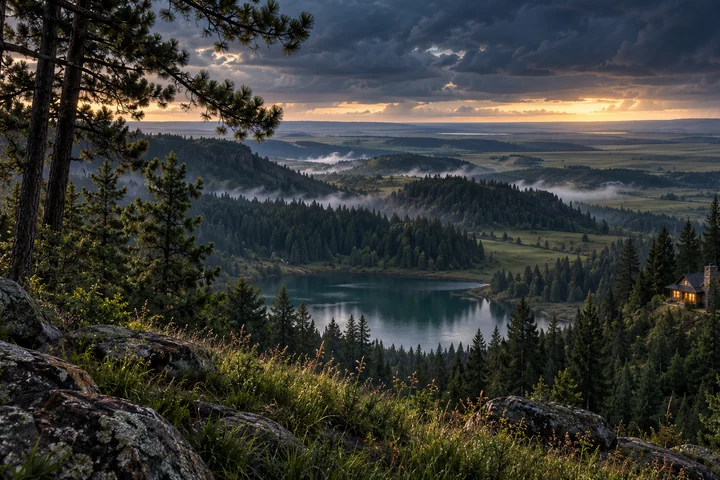
For a contrasting southeast setting, explore Cypress Hills and Elkwater, where woodland and lake sit above the plains. Our Bow Valley guide and foothill guide offer other ways of relating a country home to nearby cultural life.
When you are ready to discuss a residential acreage, share the life you have in mind with Dusko. Practical property work follows from a clear understanding of the places, activities and daily comforts that matter to you.