Alberta after dark · Stars & country life
Let the land remain part of the night.
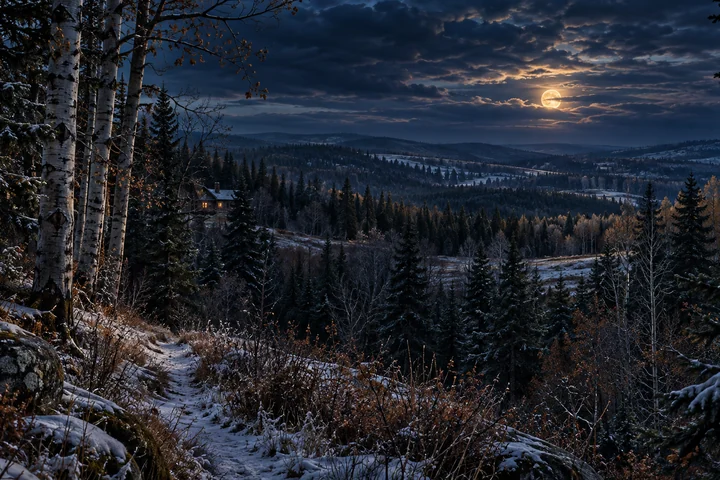
When you first step outside, look at the near landscape before searching for something in the sky. The line of a grove, the outline of a roof and the fold of a meadow give the darkness a shape. They place you within the scene rather than leaving you with an abstract field of stars.
A familiar setting is especially rewarding. You can remember the grass or the path in daylight, then notice how little is needed to recognise it after dusk. The experience lies partly in the relationship between what you see and what you know is there.
Choose one comfortable, appropriate place to stay for a while. Constant movement can turn an evening into a search for a better photograph, when the pleasure may be in allowing the same view to become more absorbing.
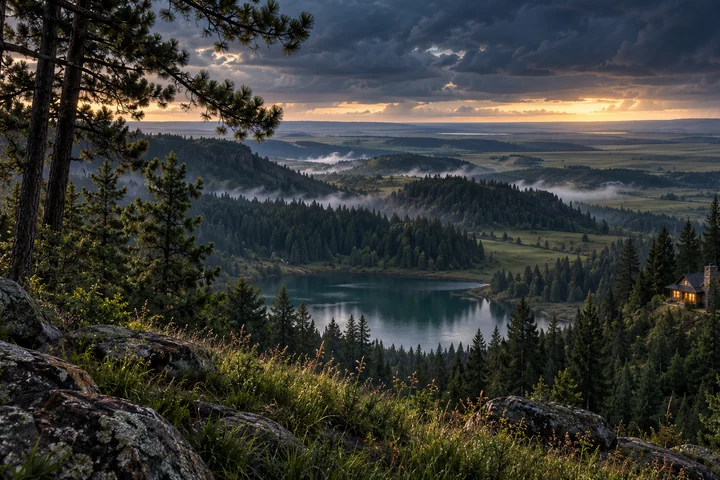
For a country home, think about that relationship between shelter and openness. A place near the house might provide enough enclosure to feel settled while still allowing a generous view upward. The night becomes something you can enjoy as part of daily life.
A foothill connection with the universe
At Rothney, the view comes with questions.
The University of Calgary’s Rothney Astrophysical Observatory is a working research and teaching facility near Priddis. Its public programme brings visitors into contact with astronomers, students and the instruments used to explore the universe.
The observatory’s history traces its inauguration to January 7, 1972 and records the Cross family’s support. That local history gives an evening visit another dimension: the setting belongs to a continuing relationship between land, learning and public curiosity.
Arrive with a question you would enjoy pursuing. You might ask how an image is made, how a telescope is directed or what researchers can infer from the light they collect. An answer can make the object in the eyepiece much more interesting than its appearance alone.
That habit of questioning can travel home with you. A country view of the sky becomes richer when it is connected with an interest you can develop, rather than reserved for the occasional night when everything seems unusually dramatic.
Alberta after dark · Stars & country life
Plan a Space Night around the actual programme.
Rothney is open to visitors during scheduled programmes and events. Its public events page, checked October 11, 2026, lists the next Space Night for November 7 and marks tickets sold out, with a waitlist. The October 10 event is already past.
Use the current event information for any future booking. The page describes talks and telescope opportunities involving university astronomers and the Royal Astronomical Society of Canada’s Calgary Centre. The programme is an encounter with people and ideas as well as a chance to observe.
The visitor guide explains that admission requires a pre-purchased ticket and that most events run under cloudy skies too, with talks and people available to answer questions. It also distinguishes the surfaces and access to particular telescopes.
Give the evening enough room in your plans. A meal beforehand and a quiet return afterward can make the visit feel complete without crowding it with other destinations. Follow the organiser’s arrival and parking instructions; an appealing rural setting is still a working facility.
Alberta after dark · Stars & country life
A first look through a telescope is only the beginning.
At an organised observing event, take time to hear what the operator is showing you. A faint object can be more absorbing when you understand the question attached to it. Ask what part of the view deserves attention and what another instrument or observing condition might reveal.
Give yourself permission to look again. The first glance may be occupied with finding the image and learning how to use the eyepiece comfortably. A second encounter can leave more attention for the subject itself.
Conversation also matters. The person operating a telescope may have spent years returning to the same kinds of objects. Asking what keeps drawing them back can make an evening feel less like a sequence of demonstrations and more like an introduction to a continuing interest.
Bring that curiosity to a modest home practice. Keep notes about a question you want to answer, a public talk you enjoyed or an object you hope to recognise another time. You do not need to turn the first evening into an equipment purchase or master everything you have just heard.
Alberta after dark · Stars & country life
The sky holds more than one tradition of looking.
Rothney’s Indigenous Skies resources introduce Blackfoot, Cree and Métis perspectives, connecting knowledge of the sky with language, land, relationships and wayfinding. They provide a route into material presented with its own cultural context.
Approach that learning with the same attention you would bring to a museum or a conversation with a knowledgeable host. Notice whose perspective is being shared, how it is introduced and which questions it opens for you.
A sky familiar through one set of names can acquire another dimension when you understand that other people have attended to it in different ways. The value lies in learning from those accounts, without flattening distinct cultures into a single general story about the stars.
At home, the response can be a continuing interest in the authorised resources, public programmes and people who share this knowledge. The sky becomes a connection with a wider human history as well as an object of scientific enquiry.
Alberta after dark · Stars & country life
Elk Island lets an evening unfold at its own pace.
Parks Canada’s stargazing guide places Elk Island within the Beaver Hills Dark Sky Preserve and welcomes visitors at night. It connects lighting practices with both the experience of the sky and the needs of wildlife.
Choose a suitable public place using current park information, then let the evening become simple. A seat, warm layers and time to look can be enough. A family visit need not become a competition to identify the most objects.
The nearby landscape gives the sky a setting. At a lake, the open horizon may draw your attention outward; beside trees, the shapes overhead can feel framed. You may discover that the place you enjoy most is chosen as much for its comfort as for its breadth of view.
Use the park’s current bulletins and programme information for the actual day. The Beaver Hills guide explores the region’s daytime culture and country life; an evening visit adds another experience without requiring every part of that larger itinerary to fit into one day.
Alberta after dark · Stars & country life
Miquelon brings parkland and night-sky interest together.
The Alberta Parks Miquelon Lake brochure identifies the park as part of the Beaver Hills Dark Sky Preserve. It offers another public setting through which to explore the relationship between parkland and the sky.
Plan an evening from the park’s current access information. A dark-sky designation describes a protected night environment; the facilities, parking and programme still have their own arrangements. Choose the experience that is actually available rather than relying on the label alone.
The current park page, checked October 11, 2026, carries a September 23 notice limiting vehicle access at the backcountry trailhead during garter snake migration and directing overflow parking to day use. The Park Centre page distinguishes winter staff availability from public visitor-centre and shop opening.
Make a plan that works without an open shop or an unconfirmed programme. A self-contained visit can feel particularly relaxed when you have settled the ordinary details before arriving. The evening is then free for the place itself.
Science, art and a mountain town
Jasper gives the night a cultural programme.
The Jasper Dark Sky Festival is scheduled for October 16–25, 2026. As checked October 11, those dates are upcoming. The organiser’s programme brings together astronomy experiences, public speakers, music and art.
The published calendar includes Symphony Under the Stars on October 17 and Art After Dark on October 23. Their presence makes an interesting invitation: a night-sky visit can include listening and looking in several different forms, rather than treating culture as something to fit around the main telescope event.
Choose the particular event that interests you and check its own arrangements. A festival calendar is a starting point; individual venues, tickets and weather-dependent experiences need their current information. Leave time in town for an ordinary meal and the transition into the evening.
For wider travel, use Parks Canada’s current Jasper planning page, which links the map of places open or still closed following the 2024 wildfire, bulletins, trail reports and seasonal roads. A festival booking does not describe access throughout the national park.
Jasper deserves its own stay. It is a different landscape and journey from the foothills near Calgary or the Beaver Hills near Edmonton, with its own community and reasons to return.
Alberta after dark · Stars & country life
Cypress Hills offers forest beneath a prairie sky.
Alberta Parks’ Cypress Hills management plan records the interprovincial park’s dark-sky designation and connects the elevated forest landscape with night viewing. That is a different setting from either a mountain valley or open prairie.
Think about the edge of the forest as part of the experience. A dark group of trees can give a generous sky a close frame, while the surrounding land remains legible in outline. The pleasure lies in that balance of enclosure and openness.
Choose a current public programme or an appropriate permitted overnight stay from the Alberta park information. The historical management plan establishes context, not a present-day observatory timetable. The Alberta and Saskatchewan parts of the interprovincial park have separate visitor arrangements.
The Cypress Hills country guide gives this visit a wider daytime setting. Allow the region to be a destination in its own right, with a night added to the stay rather than a late detour from another part of Alberta.
Alberta after dark · Stars & country life
Wood Buffalo asks you to think on a northern scale.
Wood Buffalo National Park spans the Alberta–Northwest Territories border. Parks Canada identifies it as a dark-sky preserve and places it within the traditional territories of Dene, Cree and Métis peoples. Its size and northern setting make it a journey to plan separately.
The park’s night-sky guide describes the Dark Sky Circle at Pine Lake and the Salt River day-use area. It also distinguishes the long daylight of May through July from the greater darkness available later in the year.
Read those places against the current visit-planning information, including access and current bulletins. The named viewing locations should not be presented as nearby Alberta roadside stops simply because part of the park lies within the province.
A northern stay can be rewarding precisely because it asks for more time and attention. Give the travel, community and daytime landscape a place in the visit. The night then belongs to an experience of the region, rather than becoming the sole measure of whether a long journey was worthwhile.
Alberta after dark · Stars & country life
Let an aurora be a possibility, not a deadline.
The Canadian Space Agency’s aurora guide recommends checking both geomagnetic forecasts and local weather, choosing a setting away from intrusive light and looking across the sky. It explains that clouds, precipitation and a bright Moon affect viewing.
Use those resources to decide whether a particular outing makes sense, then leave the result open. A forecast can inform a plan; it cannot turn an evening into a promised performance.
Arrange the rest of the night so it remains enjoyable. A comfortable place to wait, a companion who is happy to look quietly and a sensible point at which to return home can make the experience feel generous even when the expected colour never appears.
Photography can be a separate interest, with its own way of recording light. Give yourself time to look directly as well. The memory of being outside in a particular place may matter as much as the image you bring back.
The house after dusk
A warm window is enough to make a home feel present.
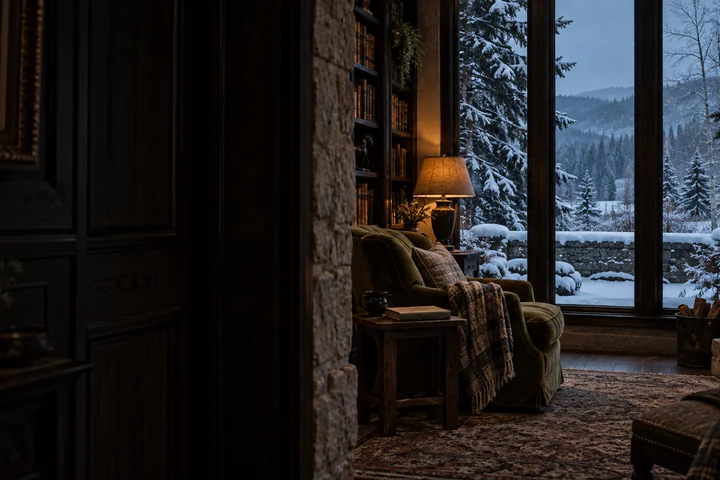
From outside, a few softly lit rooms can give a country house a strong presence. You recognise the kitchen, a reading lamp or the place where people are talking. The home appears inhabited while the wider landscape keeps its darkness.
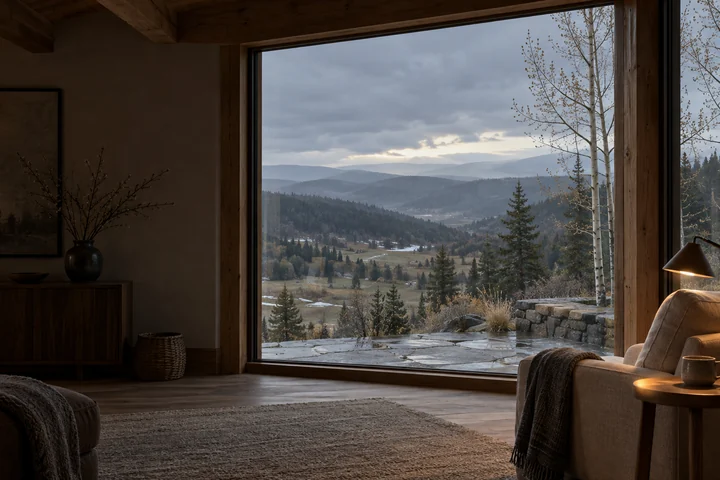
Inside, pay attention to the room’s relationship with the glass. A bright interior can turn a window into a reflection of the room itself. Experiment with the arrangement of lamps and seating to find the evening atmosphere you enjoy.
Different rooms can offer different kinds of retreat. A kitchen may remain lively after supper, while another space feels quieter and more enclosed. You need not give every part of the house the same light or the same level of activity.
During a home visit, imagine the ordinary evening rather than only the daytime tour. Where would you read? Which room would receive a friend? Is there a comfortable transition to an outdoor seat when the conditions suit?
These questions connect the idea of a dark landscape with actual domestic pleasure. The aim is a house that feels welcoming to its occupants while allowing the night outside to retain its own character.
Alberta after dark · Stars & country life
Light the useful places with care.
DarkSky International and the Illuminating Engineering Society’s lighting principles ask for light with a clear purpose, directed to the place it is needed, at an appropriate low level, controlled in time and warmer in colour where possible.
Start a home discussion with the activity. An entrance, a change in level and a place where you need to handle something each ask a different question. Explain the use before choosing a decorative fitting or a general brightness for the whole property.
Walk through a proposed arrangement with the appropriate designer or installer. The view from a seated position and the effect on adjoining land deserve attention as well as the appearance of the fixture itself.
A thoughtful result can make the small occupied area comfortable while leaving much of the setting quiet. Use the linked principles as design guidance alongside the requirements of the actual site; they are not a claim that a particular property has a certification.
Alberta after dark · Stars & country life
An evening under the sky can stay wonderfully simple.
A good gathering after dusk begins with ordinary hospitality. Have a place for people to leave their things, somewhere warm to return to and an easy way to understand the plan. The sky does not need an elaborate theme.
Let the meal have its own pace. Afterward, invite anyone interested to spend a little time outside, with an indoor alternative for the person who would rather continue a conversation. A memorable evening does not require everyone to enjoy it in exactly the same way.
One shared question can be more engaging than a long explanation. Ask what changed when you stepped out, which part of the landscape remained visible or what someone remembers from a public astronomy event.
Keep an appropriate seat and simple comforts close at hand. It is easier to stay attentive when you are comfortable, and easier to enjoy the moment when returning indoors feels straightforward.
Leave room for the unplanned ending. The conversation may become the main pleasure, or a brief look may be enough. A home gains character through these evenings without needing every one of them to become an occasion.
Alberta after dark · Stars & country life
A cloudy night can still belong to the country.
Clouds alter the experience rather than cancelling every part of it. The sky may hold less detail, while the outline of trees, the sound around the house and the light from a room become more noticeable.
If conditions make an outdoor plan unsuitable, give the indoor evening a proper shape. Put a book where you want to sit, choose music you will actually listen to or return to a question from a recent talk. A country stay should have satisfying hours that do not depend on a perfect forecast.
A gallery visit or a museum afternoon can also carry into the night through conversation. The relationship between the two guides is intentional: woodland architecture and garden history offer interests that continue when there is little to see overhead.
For guests, a clear change of plan is often all that is needed. People can enjoy an evening that has become quieter, provided it still feels considered. The disappointment usually comes from treating every other pleasure as merely waiting for the weather to improve.
Allow the house to do its share. A comfortable interior makes it possible to enjoy the wider setting over many visits, including those when the view is subdued.
Alberta after dark · Stars & country life
The sky can become a continuing interest.
Begin with one thing you want to recognise or understand better. It might come from a Rothney talk, a park programme or a question raised by an Indigenous Skies resource. Follow it over several evenings rather than trying to assemble a complete knowledge of the sky at once.
Keep a simple record of place, date and what held your attention. Include the landscape as well as the subject overhead: a grove beside the seat, a distant light or the room you returned to. The record can show what makes a night enjoyable for you.
Public events offer a way to develop that interest with other people. Check the current programme, arrive ready to listen and ask a question. The community around astronomy can become as rewarding as learning to recognise another object.
When considering a residential acreage, describe the evening life you want alongside the daytime view. A comfortable home, an appropriate outdoor place and a setting you enjoy repeatedly form a more useful starting point than an expectation of spectacular stars every night.
Explore the foothills, Beaver Hills and Peace Country guides for different daytime settings, then bring your priorities to Dusko through the residential acreage site.